Pages

Showing posts with label Pagan Holy Days. Show all posts

Thursday, February 2, 2012

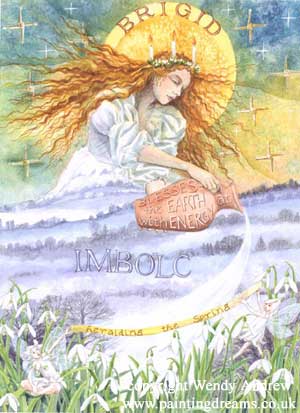
Imbolc Blessings, February 2, 2012


Groundhog Day, February 2nd is known as the high Celtic feast day of Imbolc. 
Snow is on the ground and it seems as if winter will not end.  However, with the arrival of Imbolc comes the hope of Spring.   It is a time to call upon the universe to warm and heal us.  It is a time to be inspired. 
There are healing herbs for our mind, body and spirit to get us through the remainder of winter.  Think of the warmth of cinnamon in the air, the healing of evergreen or eucalyptus.  The uplifting aroma of citrus brightens the spirit.  This can be used in teas or a small amount sprinkled on a candle to release the aroma.  And of course, let’s not forget the concept of cooking.
We need to remind ourselves to use our power and the gift of the elements to balance, ground, and rejuvenate ourselves.   Use the color turquoise for healing and poetry to fan the flame of inspiration.
In Ireland and Scotland, the women make dolls from corn husks and carry them from home to home.  Her name is Bridget and she is decorated with flowers, shells, stones and ribbons.  Elements of the earth to be honored and cherished.   The children chant Bridget is coming, Bridget is coming.
Perhaps you could make a similar item at home and light a fire or candle to honor her and the earth.
Work on leaving the winter behind and prepare for a bright, new spring.   After all, Spring is coming and with it new growth and a new freshness.  Embrace it.

posted by Dsandra

Saturday, December 19, 2009

Winter Solstice and Yule!


The Winter Solstice, or Yule, occurs on Monday, December 21
st at 9:43 am. Yule represents a turning point of the solar year as the days begin to get longer after this time of greatest darkness and the longest night of the year. Yule is a solar festival, celebrated with fire and decorating trees, giving gifts, burning a Yule log, harvesting mistletoe and hanging evergreen boughs. After feasting, the tree is lighted and the Yule log is burned. A portion of the Yule log is saved to be used in next years lighting of the Yule log. This piece of the Yule log is kept throughout the year to protect the home.

The seasons’ colors are red and green. Holly is used as decoration for this festival, originally named for the dark underground Crone-goddess Holle, or Hel, from whose womb the sun arose. The red berry symbolized the Goddess’ holy blood, shaper of all life, according to the oldest beliefs. The evergreen leaves of the holly represent ongoing life, retaining vitality through the winter, with an implied promise of immortality.

The Winter Solstice has long been associated with the birth of a ‘Divine child or King’ long before the rise of Christianity. Since the Sun represents the male deity, this time is honored as the return of the sun god, where he is reborn of the Goddess. Yule is centered around the idea of rebirth, assisting the newly born sun to grow in strength when it emerged from the dark womb of night. It is a time for reflection and celebration as we think about where we have been and anticipate the new Sun and its promise for increasing light, as the days start to slowly become longer and warmer. The theme for Yule, is re-birth, with emphasis on the divine birth-giver rather than the one born, as in the Christian revision. The birth-giver is Hel, or the Dark Goddess, also known as Mother Night, Hecate, Myrrha, Cerridwen, Cybele-Nana, Black Demeter and many other names.

Savior cults, such as of those of Jesus, Mithras and Attis, use this traditional birth season for their heroes and dying-resurrecting ‘god men’. In ancient cultures, they celebrated the birth of a divine child at this time, nine months after the god’s death and re-conception (resurrection) at the Spring Equinox.